
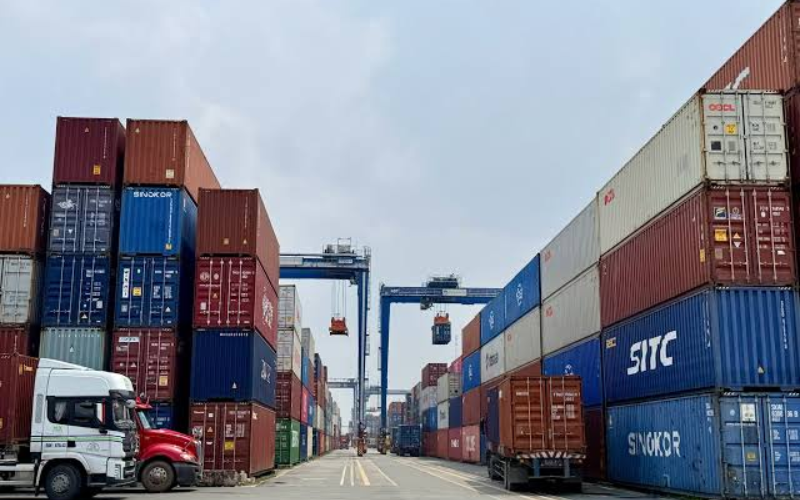
CY stands for Container Yard. It is an area inside or near the port, or at a depot, used to stage whole containers. The CY is the handover point for containers between the cargo owner, the domestic haulier, and the shipping line.
At the CY, handling is done on the whole container, without opening individual packages inside. For that reason, costs are usually charged per 20 foot or 40 foot container. For FCL cargo, goods are usually stuffed into the container at the shipper's warehouse, and the container then goes straight to the port's CY. For container transport services, businesses should confirm the CY and the container cut off time when booking.
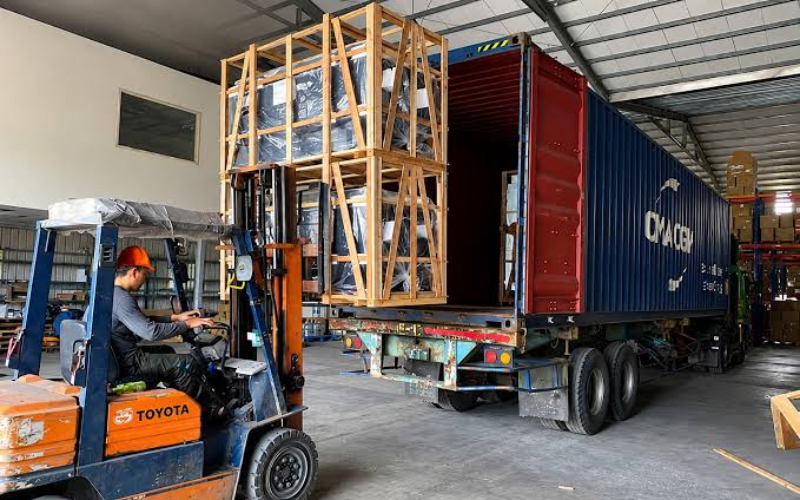
CFS stands for Container Freight Station, which can be described as a loose cargo station or a consolidation warehouse for LCL. It is where LCL cargo is handled, meaning goods from several cargo owners sharing one container.
At the port of loading, LCL cargo from several owners is brought to the CFS. A consolidator groups the lots going to the same destination port and stuffs them together into one container. At the port of discharge, the container is taken to the CFS to be stripped, and the cargo is delivered to each consignee. Costs at the CFS are usually charged per cubic meter (CBM) or per revenue ton, depending on whether weight or volume is greater.
The core difference lies in what is being handled. The CY handles whole containers, while the CFS handles loose cargo. To see the difference between CFS and CY at a glance, you can use the table below.
| Criteria | CY (Container Yard) | CFS (Container Freight Station) |
| Typical cargo | Full container load (FCL) of one cargo owner | Less than container load (LCL) from several cargo owners |
| What is handled | Whole containers | Individual lots and packages |
| Main work | Staging, handover of containers | Consolidating, stuffing, stripping, splitting cargo |
| Common fee basis | Per 20 foot or 40 foot container | Per CBM or revenue ton |
Because each lot has to be handled separately, fees at the CFS warehouse are usually higher than the lift off charge at the CY.
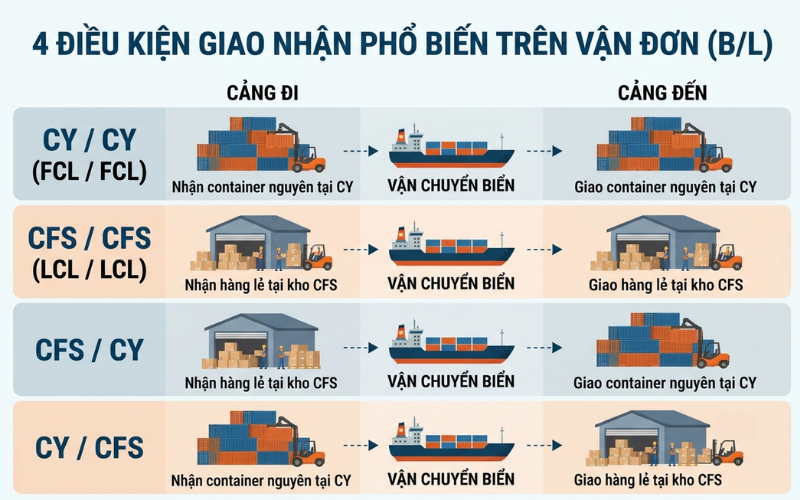
On the booking and the bill of lading, the delivery term shows where the cargo is received and delivered at each end of the journey. The first symbol is where cargo is received at the port of loading, and the second is where cargo is delivered at the port of discharge.
The shipping line receives the whole container at the yard at the port of loading and delivers the whole container at the yard at the port of discharge. This is the standard term for FCL cargo. Because the container is not opened mid journey, this format reduces the risk of loss, damage, and mix ups, and the process is simpler.
Loose cargo is received at the CFS at the port of loading and delivered at the CFS at the port of discharge. This is the standard term for LCL cargo. With a consolidation service, the consolidator issues a House B/L to the cargo owner under CFS/CFS terms. The shipping line issues a Master B/L to the consolidator under CY/CY terms. Dealing with the shipping line on booking and bills of lading is usually handled by a provider of customs brokerage and vessel chartering support.
With CFS/CY, LCL cargo is consolidated at the CFS at the port of loading and then delivered as a whole container at the CY at the port of discharge. This suits buyers who source from several suppliers but want to receive a whole container at the destination, which reduces the cost of handling loose cargo at the destination end.
With CY/CFS, the whole container is received at the yard at the port of loading, and on arrival it is taken to the CFS to be stripped and the cargo split among several consignees.
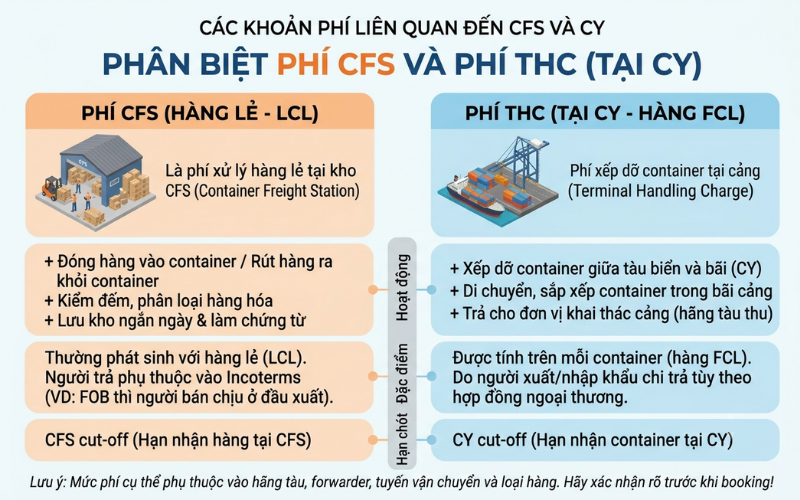
To see the difference between CFS and CY in cost terms, it helps to separate two fees that are often confused: THC and the CFS charge. THC (Terminal Handling Charge) is the fee for moving a container between the quay and the yard. It is paid to the terminal operator and is usually collected by the shipping line. The CFS charge is a local charge that usually applies to LCL cargo, covering the handling of goods at the CFS warehouse, such as stuffing, stripping, tallying, short term storage, and documentation.
The amount depends on the shipping line or forwarder, the trade lane, the type of cargo, and the tariff at the time, so businesses need to ask clearly before booking. Who bears the CFS fee also depends on the Incoterms in the sales contract. For example, under FOB terms, the seller usually bears the CFS fee at the origin.
Cut off times also differ. FCL cargo has a container cut off at the CY (CY cut off), and LCL cargo has a cargo cut off at the CFS (CFS cut off). Businesses should confirm these deadlines with the shipping line or forwarder to avoid missing the vessel. You can also read more about the types of fees in sea freight to understand each charge before receiving a quotation.
It is not accurate to assume that CY is only for FCL and CFS is strictly only for LCL. CY and CFS describe handling points in the transport chain, so one journey can have a CY at one end and a CFS at the other, as in CFS/CY or CY/CFS. The actual model depends on how the shipment is structured, the carrier, and the service that was booked. Businesses should therefore read the delivery terms shown on the booking and bill of lading carefully and compare them with the quotation. After understanding the difference between CFS and CY and choosing an option, the documents for customs declaration services should be prepared in parallel so that cargo release is not delayed.
Full container cargo suits shipments large enough to use a container efficiently. It usually moves under CY/CY terms with few intermediate handling steps. LCL cargo suits small shipments. It usually moves under CFS/CFS terms and is charged per CBM or ton, but the cargo goes through more handling steps. After cargo is stripped at the CFS, it is delivered to the warehouse by domestic transport services.
A shipment that is large enough to fill a container but still moves as LCL can cost more, because fees at the CFS warehouse are usually higher than the lift off charge at the CY. There is no fixed threshold that applies to every trade lane, so the best approach is to ask for quotations on both options. When comparing, place ocean freight, port charges, transit time, and cut off deadlines side by side.
With more than 15 years of experience in sea freight, domestic transport, container shipping, and customs declaration services, VDM Forwarder advises businesses on the shipping format that suits them, from full container cargo to LCL. The VDM Forwarder team helps customers see the difference between CFS and CY, read the delivery terms on the booking and bill of lading correctly, and clarify each port fee and cut off deadline. As a result, shipments stay on plan and unexpected costs are kept to a minimum.
If your business needs advice on a shipping plan and a detailed quotation for its shipment, VDM Forwarder is ready to help through the hotline or the company's official contact channels.

Receive shipping service price lists and optimal logistics solution advice from our experts.




We are always ready to advise and support you 24/7.